











Daily Scissor Care Routine for Busy Stylists
A daily scissor care routine takes less time than most stylists expect, and the payoff across a full week of cuts is pretty clear. This guide runs through what actually matters so you can keep your tools performing well without adding more to your day. A proper daily care routine covers five things:
- Cleaning blades between and after clients
- Oiling the pivot point correctly
- Tension adjustment that actually makes a difference
- Safe overnight storage habits
- Hygiene compliance under Australian salon regulations
Why Your Care Routine Matters More Than You Think
Neglected scissors don't just underperform — they cost you money, clients, and potentially your compliance standing. Here's what's actually at stake.
What Happens When You Skip Scissor Maintenance?
Product residue and moisture settle into the pivot faster than you'd think, and fine metal particles don't help either. Skip a few days of basic upkeep, and the scissors will usually tell you about it mid-cut, which is not great timing.
Blades that aren't wiped regularly start dragging through hair rather than cutting cleanly. Clients notice — even if they can't name it.
The Hidden Cost of Neglected Blades
Replacing a quality pair of scissors prematurely costs hundreds of dollars. Dull or poorly tensioned blades also put more strain on the hand and wrist — and over a full day of cutting, that adds up to real physical fatigue.
Hygiene, Compliance, and Australian Salon Standards
Here's where it gets serious for salon owners. Scissor hygiene isn't just about craft — it's a compliance issue with documented legal consequences.
In 2017, a Melbourne salon was forced to close after a client contracted Staphylococcus aureus from unsterilised tools. The business couldn't reopen until inspectors had solid proof that proper infection control was actually in place.
Under NSW Government regulations, non-compliant salons face fines from $110 to $2,200 and prohibition orders are displayed publicly at the entrance. Daily scissor care is business protection as much as it is craft care.
The Complete Daily Care Routine — Step by Step
Five habits. Ten minutes total across your whole day. This is the daily routine that protects your tools, your clients, and your professional reputation.
Step 1 — Wipe Blades After Every Single Client
Leave a lint-free cloth sitting right at your station, somewhere you'll actually reach for it. After each client, open the blades fully and run the cloth along both surfaces, the inner edge, and around the pivot before the next person sits down.
Ten seconds, maybe less. It clears out hair, moisture, and product before any of it gets a chance to dry and harden onto the blade.
Step 2 — Deep Clean at the End of Each Day
End-of-day cleaning is where the real hygiene work happens. Salon tools are a documented transfer risk for pathogens like Staphylococcus aureus and dermatophyte fungi, and the consequences for clients are not minor.
For disinfection, 70% isopropyl alcohol or an EPA-registered barbicide solution both work well on metal instruments. Full immersion needs 10 to 15 minutes — and always clean visible debris off blades first, or the disinfectant won't do its job properly.
Step 3 — Oil the Pivot Point (Yes, Every Day)
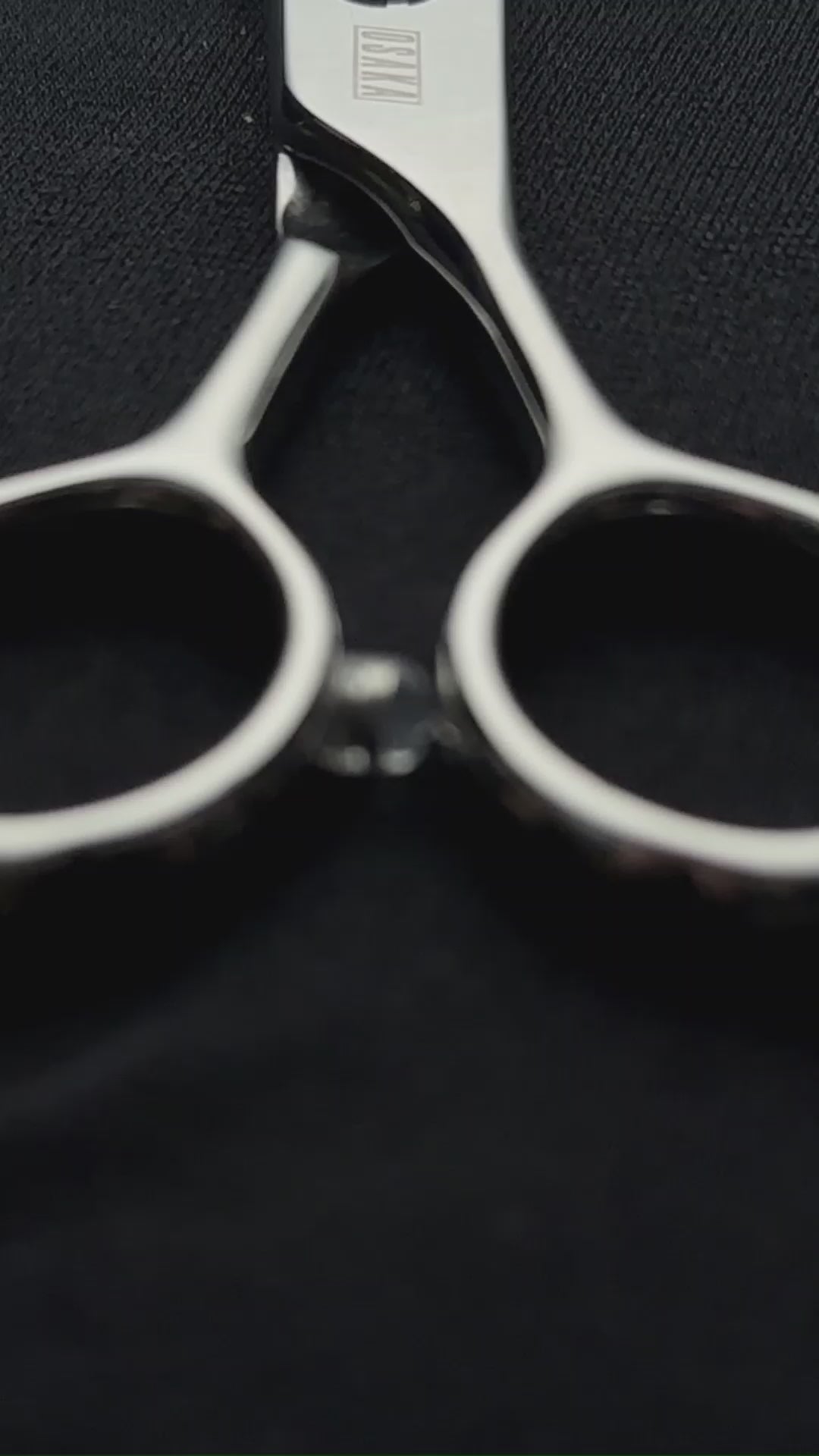
One drop of oil on the pivot, open and close the scissors a few times to move it through. And you’re done.
Skipping this causes metal-on-metal friction at the joint, gradually affecting both tension and cutting smoothness. Scissor oil costs next to nothing. A technician rebalancing a damaged pivot does not.
Step 4 — Check and Adjust Blade Tension
Before your first client each morning, open and release the scissors. They should fall to about 45 degrees — not slam shut, not stay wide open.
Too loose and blades fold hair rather than cut it. Too tight and you're loading your hand unnecessarily all day. Most scissors have a tension screw; a small turn usually sorts it.
Step 5 — Dry and Store Scissors Correctly Overnight
Moisture sitting on the blade edge and around the pivot overnight will work against the steel faster than you'd think. That goes for quality Japanese steel as well, so drying your scissors properly before storage is just part of the deal.
So after your end-of-day clean, dry them off properly and store them closed in a pouch or case. They'll be in better shape come morning, and the pivot will thank you over time.
Weekly and Monthly Scissor Care Tasks Busy Stylists Forget
Daily habits are the foundation, but your scissor maintenance routine needs a longer view. These are the tasks most stylists skip — until something goes wrong.
When to Schedule a Professional Sharpening
For most working stylists, a professional sharpening every three to six months is about right. Doing heavy volume on mixed hair types? Err on the side of sooner.
Watch for fine hair that folds instead of cutting cleanly, or extra hand pressure creeping in through the day. Those are your signs. Get it booked before a client notices it first.
How to Spot Early Signs of Blade Damage
Hold the blade up to a good light and run your thumb along the flat side, not the edge. Nicks, dull patches, or anything that catches near the tip usually show up pretty quickly that way.
A quick look under good light once a week is all it takes. Spot a nick early, and you're looking at a simple service—not a full replacement.
Building Scissor Care Into Your Salon Workflow
The reason most stylists skip maintenance is time, not intention. Wipe during client changeover. Oil at the end of your last cut. Check tension as part of your morning setup. It stops feeling like extra work pretty quickly.
Scissor Care for Australian Stylists — What Local Regulations Require
Compliance isn't optional, and the consequences of getting it wrong are public and costly. Here's exactly what Australian regulations require from working stylists.
Australian Infection Control Standards for Salon Tools
Under the Public Health Regulation 2022, any reusable instrument that contacts broken skin has to be sterilised in line with AS 5369:2023 using a steam-under-pressure bench-top autoclave. That's the standard. Other methods don't meet it, full stop.
Logging each sterilisation cycle is non-negotiable. Every entry needs the date, time, temperature, pressure, batch number, and your operator ID noted down. And all of it stays on file for a minimum of 12 months, no exceptions.
What WA and NSW Health Guidelines Say About Cleaning Scissors
NSW Health is explicit on a point worth knowing: UV light cabinets, ultrasonic cleaners, boiling water, and microwave ovens do not sterilise. Common in salons, but none meet the standard for instruments contacting broken skin.
For scissors used in standard hairdressing, thorough cleaning followed by proper disinfection is the required baseline. Skipping the cleaning before disinfection is a documented failure point that reduces the effectiveness of the entire process.
How to Stay Compliant Without Slowing Down Your Day
Compliance doesn't require a twenty-minute routine between every client.
A cloth, isopropyl spray or barbicide jar, scissor oil, and a pouch cover everything — fits on any bench corner. The stylists who find it easiest are the ones who stopped treating it as an interruption.
Choosing Scissors Worth Caring For
A good routine only goes as far as the tool being maintained. Here's what separates scissors that reward daily care from ones that don't.
What Makes a High-Quality Scissor Easier to Maintain?
Quality steel holds its edge through a full book of clients and takes to oiling and tension adjustments more consistently. For high-volume work, Japanese steel like Hitachi 440C and cobalt alloys is a genuinely different experience.
The Link Between Scissor Quality and Daily Care Effort
A well-made scissor rewards consistent care. A cheaper pair oxidises faster, the pivot loosens more readily, and the edge degrades between sharpenings in ways that are difficult to reverse.
Better tools, properly maintained, are more economical over five years than cycling through budget scissors every eighteen months.
Why Australian Stylists Are Choosing Smarter Tools
More stylists around Australia are starting to factor in tool longevity and physical wear when buying scissors. It's less about the price tag now and more about what actually holds up over a full year of daily work.

FAQs — Scissor Care for Stylists
Quick answers to the questions Australian stylists ask most about scissor care, hygiene, and compliance.
How often should I oil my hairdressing scissors?
Every day, without skipping. One drop at the pivot, work it through by opening and closing the scissors a few times, and you're done. If you're doing heavy volume, a quick midday application is worth it too.
What is the best way to clean scissors between clients?
Between clients, a quick wipe along both blade surfaces and the pivot with a lint-free cloth is all it takes. At the end of the day, go through everything with 70% isopropyl alcohol or a barbicide solution to properly disinfect the metal before you head off.
Can I use rubbing alcohol on my hairdressing scissors?
Yes, 70% isopropyl alcohol works well on metal blades and dries off fast. Let it sit for the full contact time, then dry the scissors properly and follow up with a drop of pivot oil straight after, so no moisture lingers in the joint overnight.
How do I know when my scissors need professional sharpening?
Hair folding rather than cutting cleanly, drag through fine hair, or increased hand pressure are the clearest signs. Catching it early means a lighter service and a better result.
Is a daily scissor care really necessary for busy stylists?
Fair dinkum, yes. Stylists who skip it most consistently are usually replacing scissors sooner, carrying more physical fatigue, and — for salon owners — more compliance risk than they realise.
What do Australian health regulations say about salon scissor hygiene?
Every tool that touches a client needs to be cleaned and disinfected between uses. And anything that contacts broken skin has to go through an autoclave that meets AS 5369:2023 standards, with sterilisation records kept for at least 12 months.
The Scissors You've Been Maintaining Deserve to Actually Be Worth It
You've got the routine. Now make sure the tools are keeping up with you.
A great scissor care routine only goes as far as the scissors themselves — and at OSAKA, we've spent over 30 years crafting tools from premium Japanese steel built for real-world, high-volume salon work.
Browse the full OSAKA range here and find a pair suited to how you actually work. You can also get in touch with the team for a personalised recommendation here.